

Introduction
Staff M:
Today, we will once again be sitting down with the sculptor, Hattori-san.
Thank you for joining us today. First and foremost, I would like to say that I am thrilled to speak to you again, this time about the ARTFX J Nicholas D. Wolfwood TRIGUN STAMPEDE Ver. figure that you sculpted.
One of the reasons I wanted to do this interview was because of the sculpt. The first time I saw it was at February's Kotobukiya Collection. I was absolutely blown away. I crouched down to get a picture from the front, but then I had to get up to take one from the top as well... and then move this way and that to take it from every other angle I could.
Because, you know, you can't move the sculpt itself.

Hattori:
So you have to move yourself.
Staff M:
Exactly! I know the people behind me were probably like, "What is this guy doing?"
Hattori:
I bet they had no idea you were actually a Kotobukiya blog writer.
Staff M:
If they read this, some might realize that that weirdo was actually me, haha. I knew the figure would be on display there, but I had no idea I'd get that excited.
Hattori:
Thank you. I'm glad to hear that.
Staff M:
Did you know that it was going to be at Kotobukiya Collection?
Hattori:
Yeah, of course. We'd been working on the figure to show at the event, and I'm just thankful we made it in time. It was amazing to see everyone posting about it on social media.
Staff M:
Last time I sat down to interview you about the ARTFX J Vash the Stampede -The Gunman in Black- TRIGUN STAMPEDE Ver. figure, you said that you first learned about the Trigun series through a figure, not the anime or manga.
Do you remember which character the figure was?
Hattori:
It was Vash.
The red is so hard to miss, you know? Even if you don't know who it is, it still makes you think, "Who's this red guy?" He just seemed so cool the more I looked at him. So yeah, Vash was the character that introduced me to the series.
Staff M:
But after that, you also bought figures of the other characters too, right?
Hattori:
Yeah, pretty much all of them—from Kaiyodo's action figures to busts and statues.
The sculptors who work on the Trigun figures, both back then and now, are incredibly talented.
There's Masaki Apsy, who's worked with us here at Kotobukiya, Katsuhisa Yamaguchi, who is behind the now iconic "Amazing Yamaguchi" articulation, and Tomohide Enoki, who makes busts and vignettes. With such renowned names working on Trigun, the figures are, of course, incredible.
Staff M:
Did you sort of look up to their figures?
Hattori:
Yeah, and I still do.
Staff M:
It seems like that first Trigun figure was a real turning point in your career. The reason I asked was because I thought there was a chance the first figure you saw was of Wolfwood.
Hattori:
I mean, I fell in love with Wolfwood at the same time too.
Do you remember the Vash action figure that Mcfarlane released?
That was crazy too.
Staff M:
I'm impressed you were able to get your hands on something like that.
Hattori:
It was actually easy to get in Japan. But, man, was it something else.
Staff M:
I remember the coat looking so cool. Vash's coat is one of the first things that really sticks with you, right? Not just the color but the detailing as well. They really stay with you.
Hattori:
Yeah.
Staff M:
Thanks for telling us all of that.
The reason I brought up how you came across the series was because I wanted to ask about Wolfwood in TRIGUN STAMPEDE.
I loved his new design when I first watched the series. His slightly cropped pants—and this kind of gets into the weeds a bit—but I love that they gave him these light-weight, low-cut black shoes too.
What did you think when you first saw him?
Hattori:
Did you know that they're called kung fu shoes? You know what kung fu is, right? Like Bruce Lee and Jackie Chan.
Staff M:
Really?! I had no idea!
Hattori:
As for the pants, I think they went with a cropped look because the anime's character designer has a really keen eye for what's trendy at the moment.

Staff M:
They're small details but super important, right?
Hattori:
Yeah, because you can see his ankles now.
Staff M:
Exactly! I love how it completely changes his vibe.
Hattori:
Yeah, he looks very cool.
Staff M:
Thanks for telling us all of that.
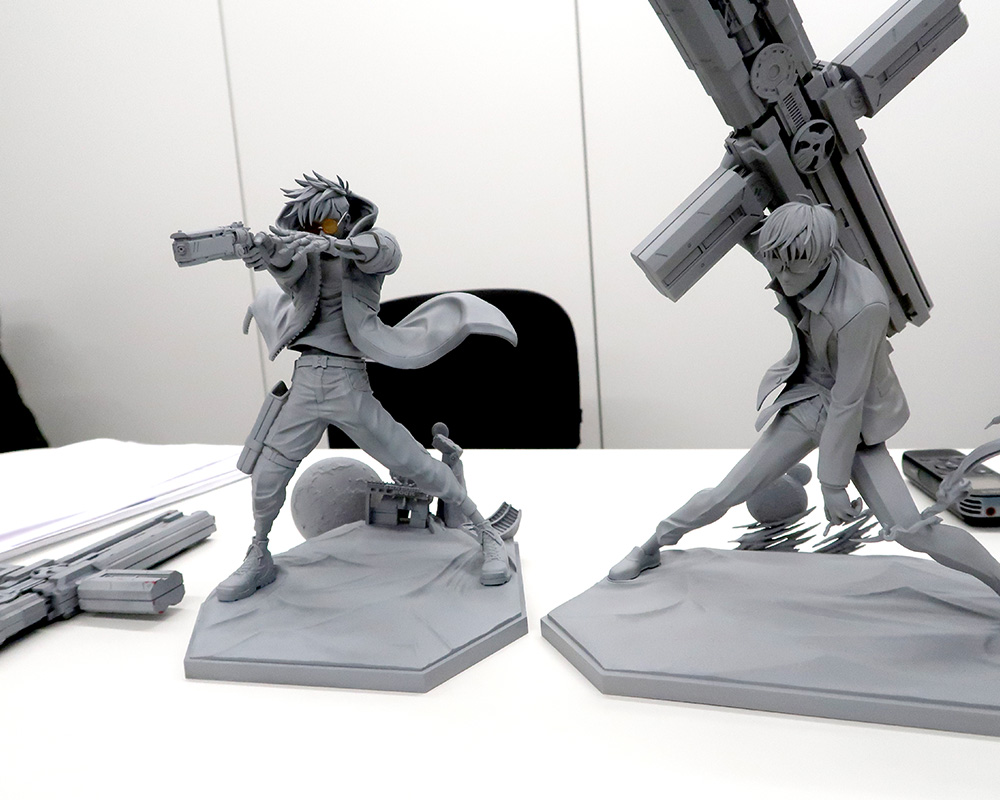
Changing topics a little—we couldn't bring the paint master of ARTFX J Nicholas D. Wolfwood TRIGUN STAMPEDE Ver. to this interview, so we have the sculpt that I actually first saw at Kotobukiya Collection. The reason we couldn't bring the painted version is, fortunately, because it's currently on display at the TRIGUN STAMPEDE EXHIBITION in Ikebukuro (at the time of this interview). I haven't had a chance to go yet, but you've already been, right?
Hattori:
I have! We're doing this interview right in the middle of the TRIGUN STAMPEDE EXHIBITION, haha.
By the time this blog gets uploaded, the exhibition will probably already be over. But since the fully painted version of Wolfwood is over there at the moment, we just have the unpainted one here today.
I had work the day it started so I couldn't make it but I managed to go on the second day.
Staff M:
I wanna go soon, too!
Hattori:
You should! ASAP!!!
Staff M:
So yeah, I still haven't seen the paint master.
Hattori:
You'll be blown away.
Staff M:
I think so, too. I'll try not to look too weird to the people behind me when I take photos this time though, haha.
Hattori:
Also, my replica Peace Bringer is also on display there!
We really didn’t know if it would be a part of the exhibition yet when we were doing the last interview
Staff M:
Right. I remember you didn't know if it would be put on display when we talked about how you made the replica for the Vash figure. I was so curious to see if it would be there that I immediately hopped on the internet to see what people were saying on the morning of the exhibit, and there it was!
Hattori:
Yup! You'll see when you go, but it's in a great spot, too.
Right by the entrance. It's at the very beginning of the exhibit.
I'm so grateful they put it somewhere like that.
Staff M:
I bet all the Trigun fans out there can't wait to see it. Especially since the Peace Bringer is essential to the show. And you almost never see it in this scale ever. So I guess that means both your fully painted Wolfwood figure and replica of Vash's Peace Bringer made it into the exhibit!
Hattori:
They did!
Staff M:
It's funny how things work out sometimes. I remember seeing the replica on your work desk and going "What is this thing?!"
Hattori:
Yeah, I just had it sitting around.
Staff M:
But then that became the trigger for this interview.
Hattori:
And now it's being displayed at an exhibition.
Staff M:
What are the chances, huh?
Hattori:
No kidding.
Staff M:
Thanks for telling us all about that.
And now I'd like to start asking you about the figure.
Topic 1. The Miracle Pose
Staff M:
This is a topic I had to ask about since it's one of the things that made me fall in love with the figure so much. I feel like you came up with the perfect pose for this figure. It's super hard to explain, but you captured both Wolfwood's vibe and personality. I'd love to hear how you landed on this pose in particular.
Hattori:
When we were first designing the figure, we actually put forward three different poses.
I think this was back in June of 2023. But of those three, this was the one we ended up going with. Both the product planner, Naito-san and I felt that it had to be this one.
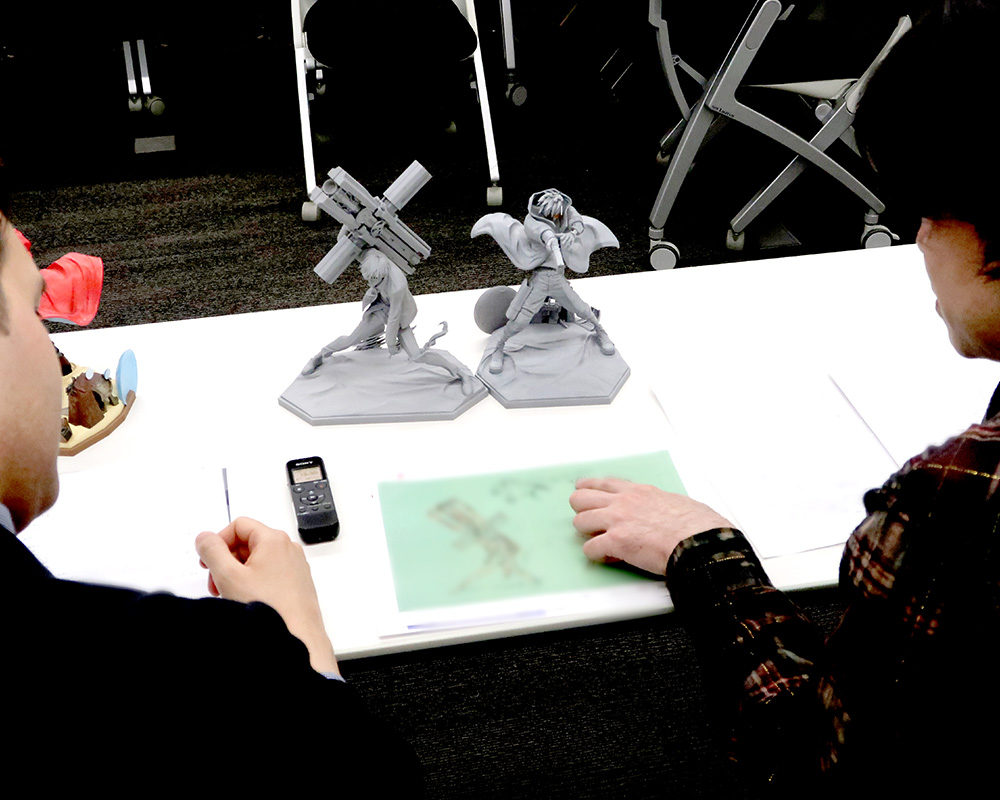
The pose itself was almost ripped straight out of the reference materials we received from Studio Orange.
And speaking of the Trigun exhibition, those reference materials are actually on display as well. I'm sure that some of you may have noticed that the figure is based on one of those drawings.
Staff M:
So that’s where you got that amazing pose from!
Hattori:
From the line work and hand-written notes, I think Nightow probably drew it himself. I'm not certain though.
Staff M:
Maybe that's why it captures Wolfwood's personality so well. How awesome is that.
The other proposed poses are cool too, but this one just stands out.
Hattori:
Yeah, the other two poses had the Punisher almost touching the ground, but in the one we ended up going with, he's got it fully slung over his shoulder. It just has a completely different aura.
Staff M:
I feel like that may be the key to this pose. You, the sculptor would have had to picture the figure from every angle to bring such a cool drawing to life, right? I imagine that was quite a challenge.


※Completed Sculpt
Hattori:
Yeah, it always is.
But that's my job. I believe it's our job as sculptors to take a drawing and make it look cool from all angles when bringing it into 3D—when turning it into a figure. So, I just did what I could to make that happen, haha.
Staff M:
Yeah, because it's not like you'd ever see someone doing this pose in real life either, right? So you have to imagine what it would look like for someone to carry something so massive in 360 degrees. It must be really tough figuring out how things like his clothes will flow and move, right?
Hattori:
Well, exactly, because it's not like we can go and make a full-scale replica of the Punisher either.
Staff M:
True. Wolfwood's carrying this massive Punisher, but he doesn't seem to be straining very much. It's like he's got it perfectly balanced.
Hattori:
I feel like being able to handle the Punisher so easily is part of his character. If he was straining, it wouldn't look very cool, right? It's not like it's effortless or light, but the way he handles it with ease is what makes Wolfwood so cool. I think we did a good job expressing that in the figure.

Staff M:
This pose reflects his character so well, and I think that’s why it feels so perfect. But more than that, thanks to this pose, both Wolfwood and the Punisher can be appreciated from all angles. I think there is a ton to enjoy about this figure for both collectors and fans of the character alike.
Hattori:
Thank you.
Staff M:
I'm glad we were able to learn how this pose came about.
So far, we've been talking about the pose, but now I'd like to ask about the face.
Topic 2: Style
Eyes
Staff M:
Spoiler alert for those who haven’t watched the anime yet, but while there are a lot of scenes where Wolfwood is smiling, he is actually quite a troubled character. I feel like you can really see his serious side in the figure. Was that intentional?

Hattori:
Of course. The fact that he has the Punisher fully opened shows you just how serious he is. We wanted to make it look like he's ready to go out before Vash and take care of business. Because, you know, that's the kind of guy he is.
Staff M:
I think you really brought out that tension. You also captured each of their feelings, too—with Vash being one to avoid fights, while Wolfwood steps up to fight. The eyes were one of my favorite parts of the figure. I bet it's difficult to express the nuances with just the eyes and face, especially for such a strong character like Wolfwood, but I guess sculptors are always thinking about that kind of stuff, right?

Hattori:
Yeah, fans of the series will know—Vash and Wolfwood have fundamentally different ways of seeing the world, which leads to them butting heads sometimes. But because that's such a core aspect of their characters, I really wanted to make sure we expressed that in the figures, too.
Staff M:
Thank you.
Sunglasses
Staff M:
I think a lot of people immediately think of his sunglasses when picturing Wolfwood. It's one of the character's most defining features. Also, choosing sunglasses usually takes ages, so it must have been tough coming up with a pair that suits him.
Hattori:
Yeah, while I do have plenty of experience sculpting glasses for characters, what's more important is the anime reference material. Anime creators spend hours upon hours deciding on every little detail before committing it to paper and we are simply borrowing that design. The anime already has it down pat, so it's our job to take that and bring every minute detail into 3D and the sunglasses naturally suited him. So, you know, it's really the animation staff at Studio Orange who are doing the heavy lifting.
Staff M:
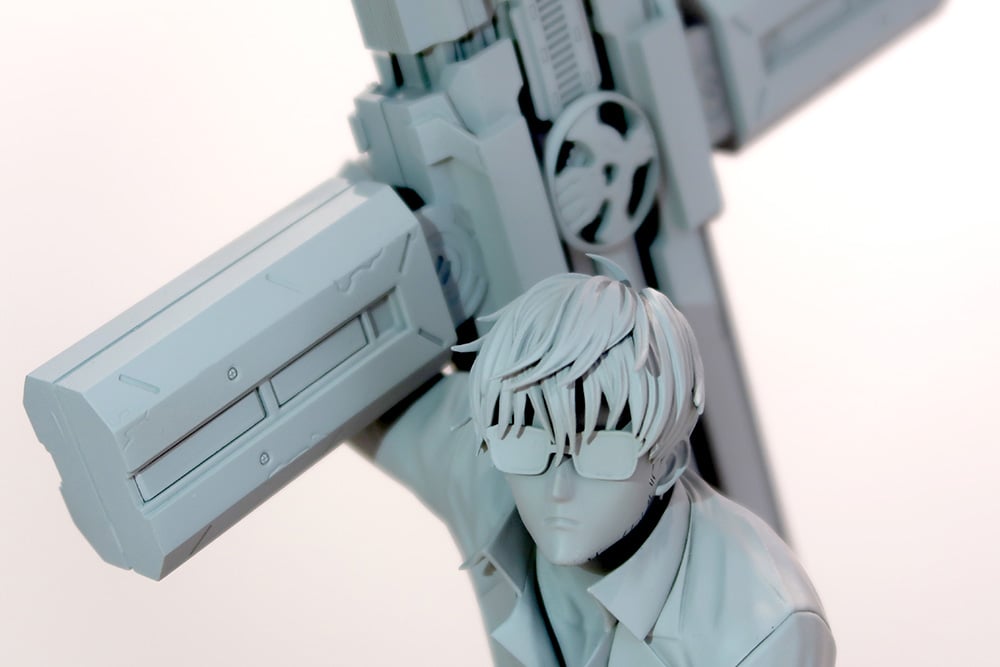
When I first saw the prototype, it was all-grey, so I couldn't see his eyes, but his face with the sunglasses on stood out so much that I had to get up close and take a photo. I just thought they suited him so well.
Hattori:
Oh, there's one more thing. The sculpt is all gray, right? Which means the sunglasses aren't see-through. This was another huge challenge because I couldn’t actually see his eyes through the lenses.
Staff M:
So you had to imagine the eyes behind the glasses. That's amazing!
Hattori:
On the computer, we can make the lenses translucent, but the most important part is how the finished product looks in real life. So, we had to think hard about how the eyes would look once the clear parts come in and the glasses are made see-through.

Staff M:
And this is the result—you can see them clearly in the paint master.
Hattori:
Right, you can see the eyes through the glasses and where they're placed—whether it's up or down. For Wolfwood, his eyes come near the upper rim of the glasses. But because we can't see that in the grey unpainted sculpt, we had to simply imagine what they would look like.
Hair
Staff M:
I heard that this figure comes with interchangeable hair parts.
Hattori:
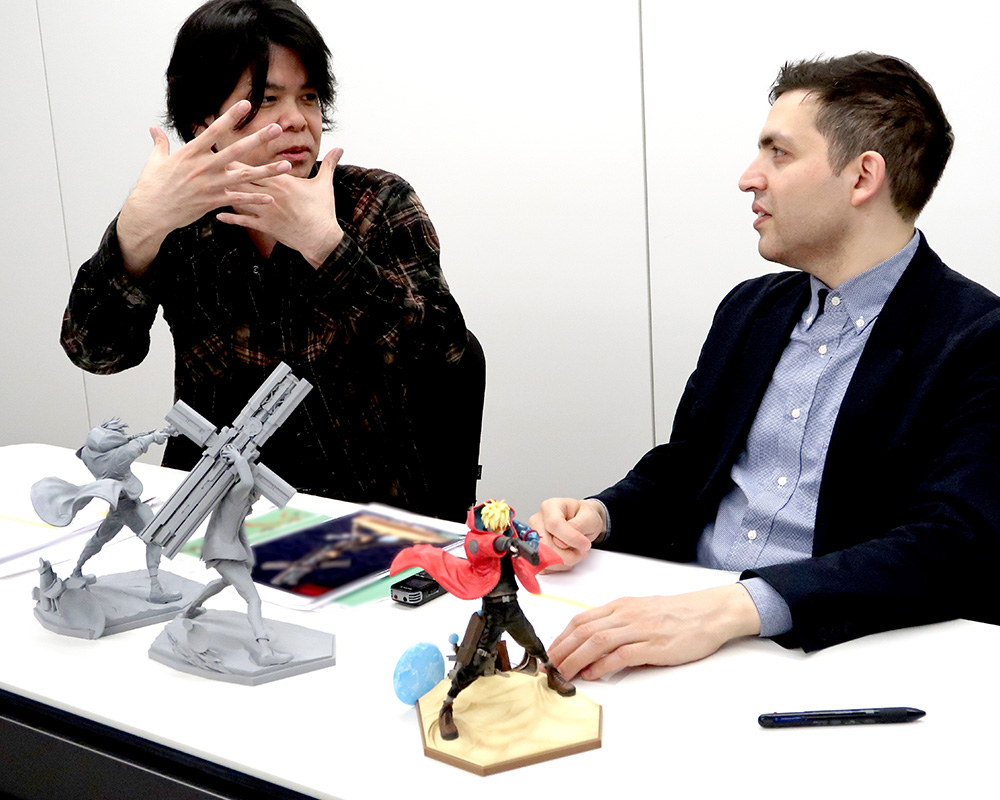
That's right—there are two versions of the front hair piece to display the figure with or without sunglasses.
Now, this might be exclusive info just for those of you reading this blog, but...
The front hair pieces actually have a slightly different sculpt. We had a technical reason for this too. It's surprisingly difficult to fit sunglasses into such a small, detailed part. So, we made a version of the hair with the sunglasses already attached.
But for the version without sunglasses, we slightly adjusted the bangs to reduce the gap between the face and the hair.
Staff M:
And that's how you balanced the hair and glasses?
Hattori:
Yeah. At first glance, they might look the same, but they're actually different.
Staff M:
It sounds like there was a lot of trial and error involved. I imagine there was a lot of "Should the hair come down to here?" or "Maybe it should sit a little further back?," trying to fine tune the design.
Hattori:
Yes. That's why we ended up with two versions. It was quite a challenge to get right… Now that you mention it, it's coming back to me just how hard it was, haha.


Staff M:
Thank you.
Suit
Staff M:
Another key aspect of Wolfwood is his suit. I think the wrinkles and creases in his shirt and jacket really create movement in the figure.
Hattori:
That's actually my favorite part, haha. We gave Vash those same kinds of creases.
Staff M:
I'm glad I asked!
Hattori:
Fabric wrinkles can be simulated in recent software, but I still like to do everything by hand.
That being said, I don't take poses and use myself as reference to see how the clothes would wrinkle in real life, either. While it might look realistic, it wouldn't make for a very interesting looking sculpt. That would be like simply replicating reality.
Instead, I think it through and run a simulation in my head—like, "If the character moves this way, would the folds appear like this?" I feel like that approach makes it look more like what you expect from a figure. So, while I'm happy if the wrinkles and creases look realistic, they're actually totally unrealistic. They're made up and stylized for each figure.

Staff M:
They're stylized! Interesting!
Hattori:
Yes. It's all part of the look.
Staff M:
I think you just hit on something really important. I personally love all the wrinkles and creases throughout the figure. It made me realize that for sculptors and artists, the real joy doesn't come from simply replicating reality—for them, it's about imagination and creating something with their own hands.
Hattori:
When the creases turn out just right, the movements of the character come to life, too. It's something that makes the figure just that much more satisfying. That's the true appeal of handmade art.
Staff M:
I really hope those who buy the figure take a close look. These aren't any ordinary wrinkles, they're HANDMADE wrinkles.
Hattori:
Yeah, you're not seeing wrinkles like these in real life, haha.
I'll be happy if some of them go "whoa!" at the sculpting I've done.


Staff M:
I also love that you can tell he's supporting the weight of his body and the Punisher with his core thanks to the wrinkles around the midriff.
Hattori:
Yeah, it's like wrinkles all go to one place.
Staff M:
Your eyes naturally look there too, so I think it's a really important detail. Thanks for telling us all of that.
The Cigarette
Staff M:
Another thing I'd really like to ask about is the cigarette. Personally, one of my favorite aspects of this figure is how he has it in his hand instead of his mouth.
Hattori:
There were definitely people within the company saying it'd be better to have it in his mouth. But with the composition as it is, having it in his hand gives the figure a better balance. You've got the massive Punisher on top of him, and then down below in his left hand, a thin, little cigarette. Plus, the way the smoke gently curls upward really balances everything out.
So, when people suggested putting the cigarette in his mouth, I'd immediately shot it down, haha. No way, absolutely not.

Staff M:
It was ruled out from the beginning? Haha.
In the last interview, you mentioned how important it was to get Vash's hand expression just right, especially the way he's gripping the cube.
This time, you've done another amazing job crafting Wolfwood's hand holding the cigarette. Can you tell us a little about the hand?
Hattori:
Well, Wolfwood's hands need to look like they could carry the Punisher, right? If they're not a little bulky, it doesn't feel convincing, so we made sure his fingers have a muscular, brawny look.
They might even be bulkier than Vash's—at least, that's what we were going for, haha.


Staff M:
Well, they have to be able to handle the Punisher. That makes perfect sense!
Hattori:
Even the joints and knuckles in the fingers have been carefully sculpted to better suit the character.
Staff M:
It's not just about the cigarette—the personality of the character, the weapon he carries—all of that influenced how his hands were designed. That's why it turned out looking so cool. Thank you.
The Magic Gap
Staff M:
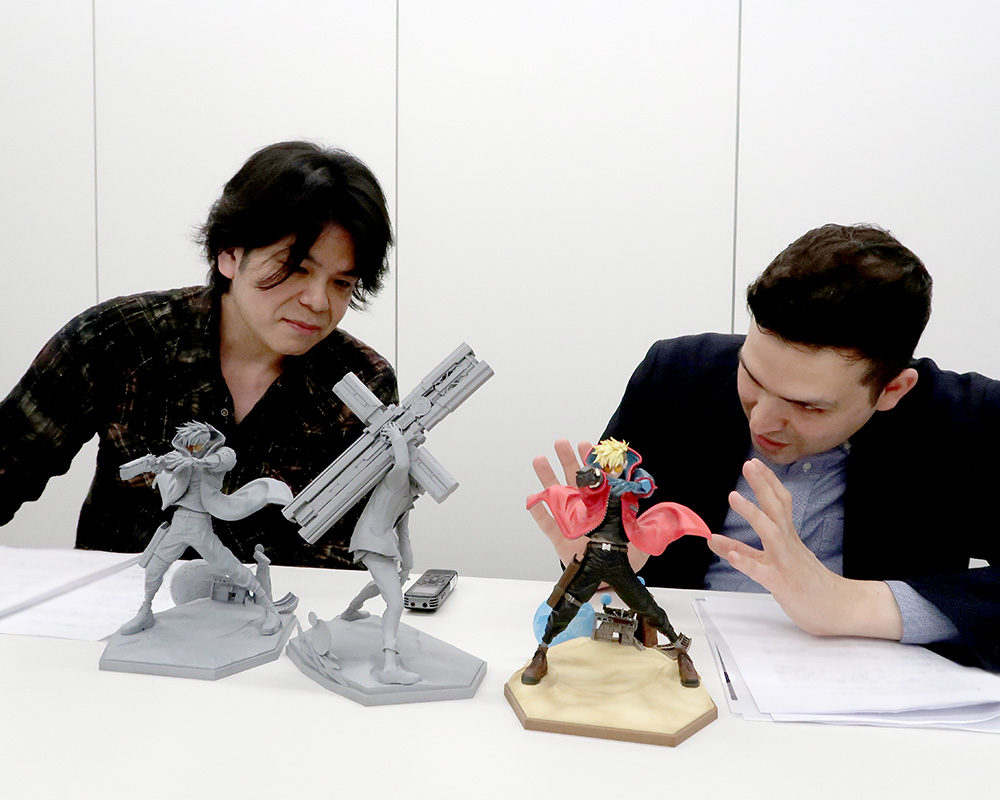
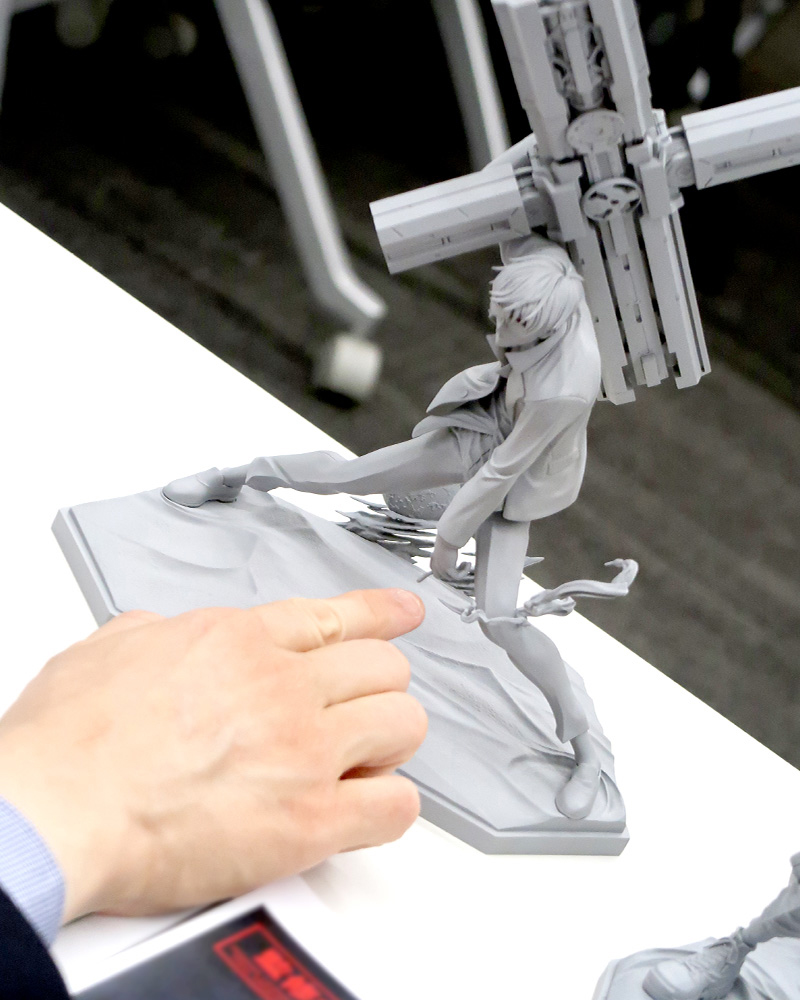
This next question is going to be pretty nerdy. Ever since I first saw the sculpt, there's something that's really stuck with me. There's a subtle but deliberate gap between the cigarette and the smoke. I really hope those who buy the figure take a closer look, because I think that small distance is incredibly important. Some people might think, “What are you even talking about?”—but can you tell us a little about this?
Hattori:
Normally, you'd try connect the smoke directly to the tip of the cigarette, right? That would be the obvious approach.
But from a technical standpoint, we couldn't insert a peg there. In other words, we couldn't physically join the tip of the cigarette to the base of the smoke. And we also wanted the starting point of the smoke to be super fine and delicate.
So then we thought, what if we just separate them? Create a small gap. But then the question became, how do we attach the smoke? The solution was to attach the peg to Wolfwood's thigh instead. That way, we could give the smoke a little gap that would preserve the airy, drifting feeling that makes it look like it's coming from the cigarette while still having it connected. That's what I'd call killing two birds with one stone.
Staff M:
I’m out of words. All I can say is that it’s beautiful. Listening to your explanation just now, I realized that the smoke tapers off into a sharp point, right? That must have been crucial for the overall look.
Hattori:
Absolutely. That was something we definitely wanted to do. I wanted to make sure it tapered.
Staff M:
I've never seen cigarette smoke sculpted so beautifully in a figure. And the fact that such a tiny gap adds so much to the overall balance is also just incredible.
Hattori:
I really feel like it was the right call to separate them.
Five years ago, I probably would've just connected them. But now, realizing, "Wait a second, we don't have to connect them," was huge.
Staff M:
From the moment I first saw it, I couldn't stop wondering about that magical gap. I wanted to know why you'd done it.
Hattori:
You’d automatically think that the smoke is coming from the cigarette, right?

Staff M:
Yeah. You don't think twice about it.
Hattori:
It was a real revelation for us.
Even just a cigarette can add a bit of style.
Staff M:
This was something I desperately wanted to ask you about today. Readers are probably thinking, "This guy is obsessed,” but hey, I don't mind, haha.

Topic 3. The Punisher
Punisher Unleashed

Staff M:
We've talked about the pose, the face, the hands, and the suit—but more than anything else, Nicholas D. Wolfwood is defined by his weapon, the Punisher. Its design and visual impact make it practically a character in its own.
What made me really happy when I first saw this figure was how prominently the beam cannon was featured in its fully open mode. Did you plan to show it like this from the beginning?
Hattori:
Feeling-wise, yes. I wanted to make it look like this from the start. But then there was the difficult question of, "Okay, so how do we actually make this thing?" Haha.
Staff M:
Was that a technical issue?
Hattori:
Yeah, there were a lot of technical challenges. I make figures all the time, but I don't usually do this kind of mech-like sculpting. So honestly, my first thought was, “Can I even pull this off?”
Staff M:
You were unsure if you could pull it off?
Hattori:
Yeah, I was. But I had to do it. I didn't want to hand it off to others. I wanted to do it myself if possible. I managed to sculpt Vash's gun on my own, so I thought I could pull this off too... probably, haha.
I started by sculpting the Punisher in its closed form, just to get a sense of the overall balance.
From there, I began thinking about how it would look when it’s open.
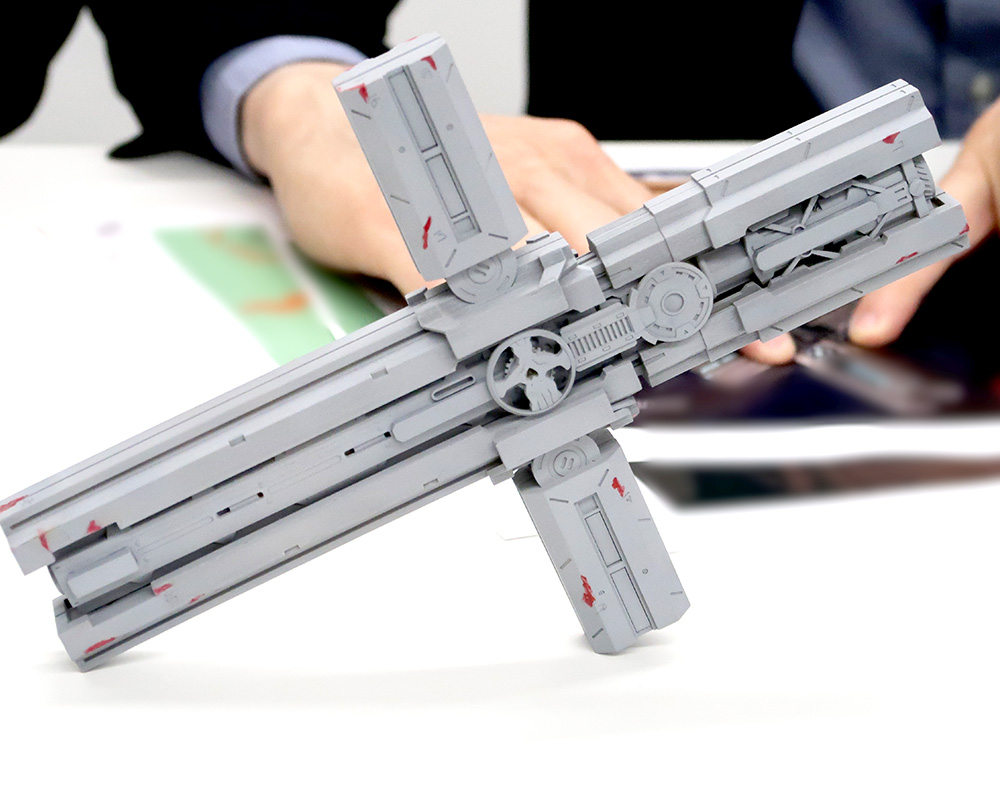
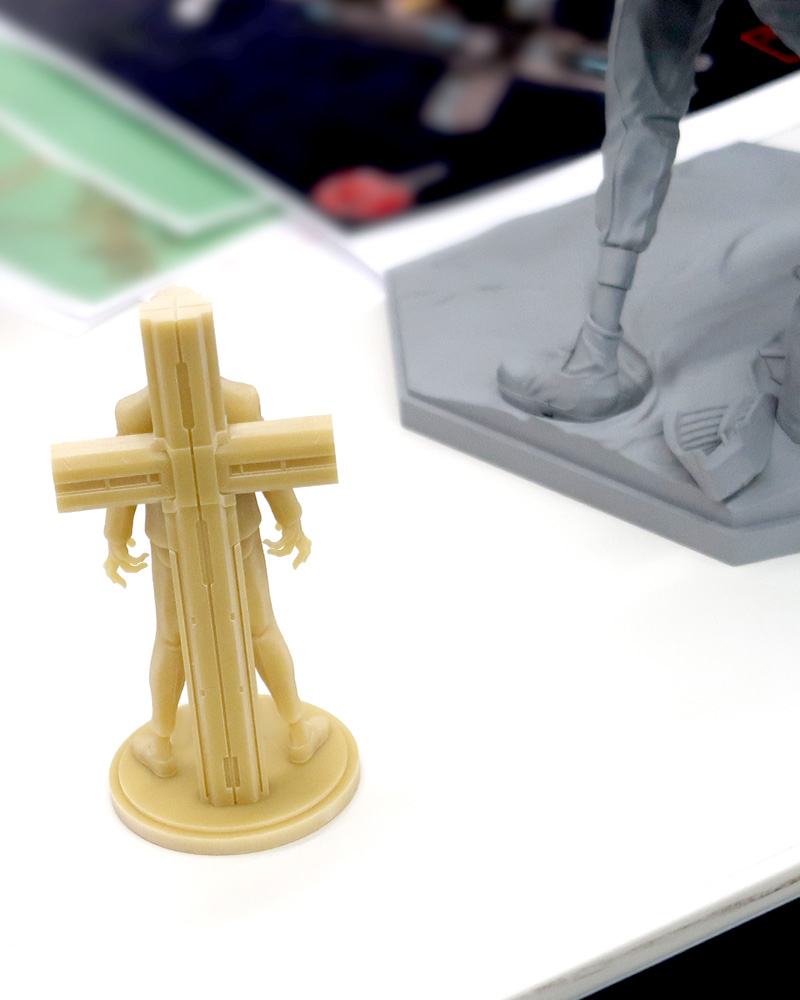
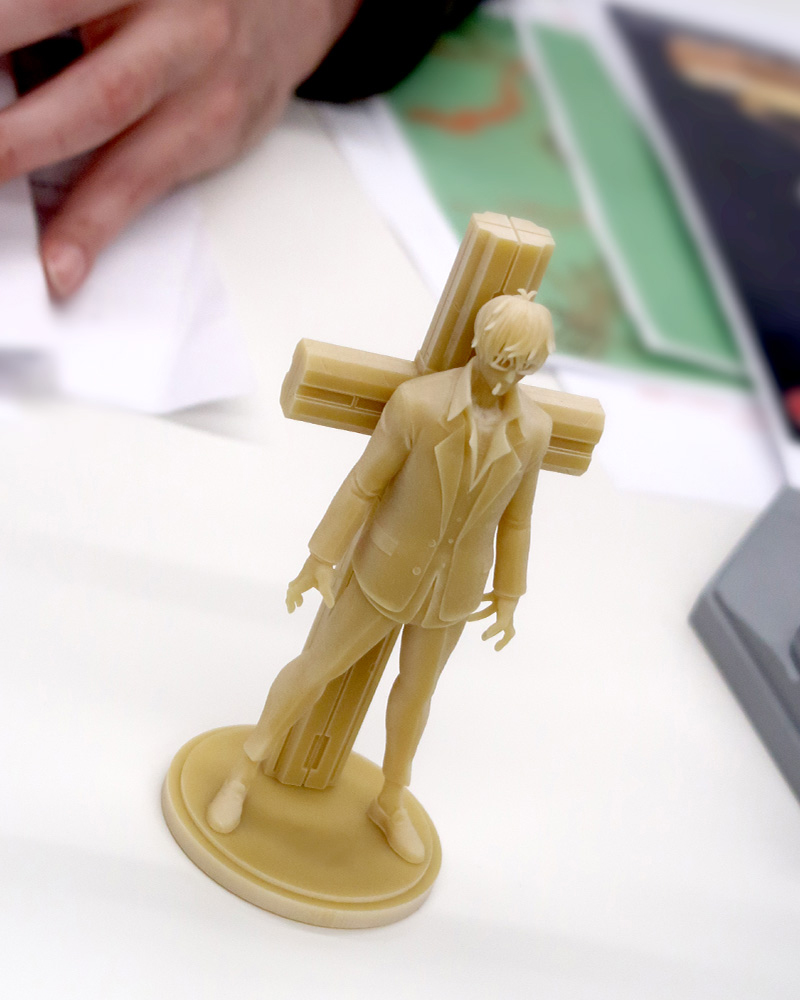
I'm not sure if readers can see the pictures, but there was a 3D printed model I made that I'd like to show. I made this first.
Staff M:
Like a prototype?
Hattori:
Yeah. I also made a version of the figure in a neutral pose first, too. From there, I thought about, "Okay, what would it look like if Wolfwood moved this way or if we opened up the Punisher?" The closed version had to look like how the Punisher looks when it's closed.
Staff M:
Right, you have to think about the fact that the weapon is actually meant to open and close.
Hattori:
In my head, the design opened and closed properly. I didn't include any of the gaps you see in the final product, but I sculpted this 3D printed prototype with the Punisher open in mind.
Staff M:
Being able to appreciate every part of the Punisher is definitely one of this figure's biggest highlights.


Hattori:
One more thing. In the other figure of Wolfwood and the Punisher, TRIGUN Badlands Rumble, Wolfwood's Punisher is wrapped up in cloth. Since we already did that version, we felt like this time, we had to do the fully exposed mech version.
Staff M:
Does that mean it was your first time sculpting the Punisher fully opened like this?
Hattori:
Yeah. When do you get the chance to build something this crazy? Haha.
Staff M:
True, this must have been a rare opportunity.
You did an incredible job.
Hattori:
Even I think so, haha.
Staff M:
Thank you.
Operating the Punisher
Staff M:
One of the things I love about the Punisher is how it's operated—how you have to grip the handle, open the right parts, and slide this specific piece to get the beam cannon. You can't just pull the trigger and fire. I just love that complexity.
Hattori:
It's, of course, based on Nightow's original weapon design, and then Studio Orange took that and brought it to life using the latest animation technology. But animating such an intricate weapon must have been such an insane challenge.
Staff M:
Yes, there are scenes that are just crazy, haha.
Hattori:
For this project, I think Studio Orange took on the most difficult challenge. Then, for me, translating that into 3D was super tough.
But, you know, that's what makes this job so great. It's tough, but it's also fun at the same time.
Staff M:
Right, haha. It was challenging, but that challenge led to what we have here in front of us.
Hattori:
When it was finally done, I looked back and thought it was all worth it.
The Grip
Staff M:
One detail I really hope people don't overlook Wolfwood's hand that's so precisely placed on the rear grip—I like to call it the skull grip. The way the hand fits in there is just beautiful.

Hattori:
Yeah, getting this to work was really hard!!
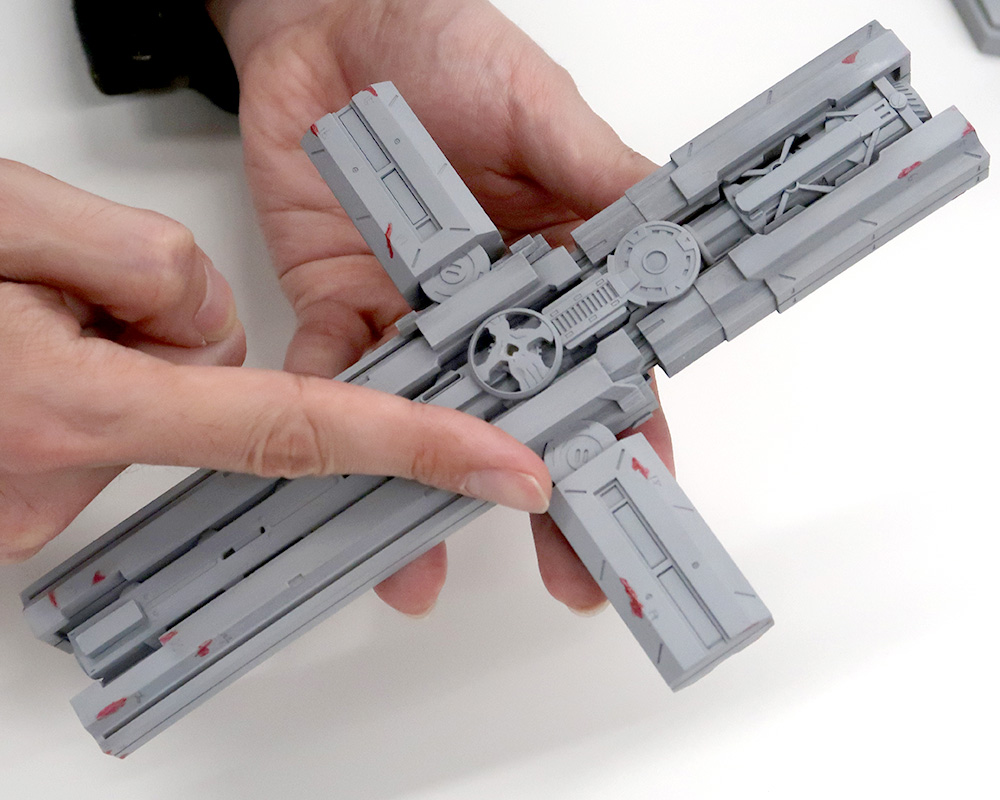
First off, his hand doesn't even fit in the grip. He has to grip it with two fingers in each opening, plus the thumb. It has to be this way. Plus, the grip isn’t just large but it’s deep as well.
Staff M:
Right, if it's too thick, he can't grip it. And then there's also the issue of the finger placement.
Hattori:
Exactly—and we had to make sure the hand could actually grip it.
Also, I'm not sure if you noticed, but the skull grip isn't symmetrical either.
Staff M:
Interesting! Tell us about that.
Hattori:
We chose to make the design asymmetrical.
The original design is meant to be symmetrical, I think, but for this figure, doing so wouldn't allow the thick fingers to fit properly.
Staff M:
Plus, it makes the skull look more menacing.
Hattori:
I really have to thank Studio Orange for being kind enough to approve this.
Staff M:
Interesting. Did you kind of have to move things around a little?
Hattori:
Making the skull slightly asymmetrical not only helped make it look more sinister but also allowed the fingers to fit. It's a small thing, but I think it has a big impact on the overall look.
Staff M:
True, because this part really stands out.
Hattori:
It might be hard to notice how asymmetric it is from just the photos, but this is the kind of thing that can only be expressed in figures.
Staff M:
I think that little tweak really added to the appeal.
Hattori:
If we had been told to make it perfectly symmetrical, we wouldn't have been able to make the hand look this good.
The look we were able to achieve might've been lost.
Staff M:
For anyone who picks up the figure, definitely give the skull grip a closer look. The figure obviously looks great from the front, but I love how he has his arm behind him holding the Punisher.
Hattori:
Yeah, I'm impressed he's able to carry it like that.
Staff M:
Thank you for letting us in on how you got the hand gripping the skull grip to look so good.
Topic 4. The Paintwork on the Punisher
The New Punisher
Staff M:
Now, I'd like to talk about the paintwork on the Punisher.
The combination of black framing and fluorescent green parts gives it such a striking color scheme. How did you approach recreating the colors we see in the anime in real life?
Hattori:
The painter for this figure is the same person who did Vash and The Gunman in Black Vash, so since this is the third in the series, we were already confident that they would do a good job.
For the finer details, we focused on how to make them more visually striking.
Instead of just using plain black or gray, we blended in metallic tones.

Staff M:
The frame isn't reflective, but it still looks metallic.
It's also different from the color of the suit.
Hattori:
Yeah, the contrast between the suit and the Punisher was intentional.
Staff M:
One of my favorite parts is all the small scuffs and scratches where the black paint has worn away to reveal the neon green underneath, like around the barrel of the beam cannon. A completely unscratched Punisher just wouldn't feel right.


Hattori:
Yeah, we added weathering around the Punisher.
Staff M:
I absolutely love it.
Hattori:
This was also super difficult. Creating the weathering and painting it isn't that hard, but then mass producing that same effect is a whole other story, haha.
It made us think, "Okay, so how many points of weathering are there actually?"
Staff M:
There's quite a few, isn't there?
Hattori:
Yeah. I had to discuss with the development team how many points of weathering we could realistically include in the mass-produced version. They said we could maybe do around 40 at max. I got them to discuss with the manufacturer beforehand and get a concrete number.
Then, I made a mock-up of where I'd like to weather. See these red marks?

※The marked sections on the Punisher sculpt are for the painting team and designate the painted damaged areas that are possible for production.
Staff M:
This red was part of the weather mock-up.
Hattori:
But then, when I actually got to painting, 40 wasn't actually that many.
Staff M:
Really? It feels like it would be a lot.
Hattori:
Yeah. So it was really important that we strategically place the weathering across about 40 points to achieve the most visual impact.
Staff M:
That sounds really tough.
Even in the prototyping stage, you already had to map out where you'd put the weather around the muzzle, barrel and frame to make it look the best it could, right?
Hattori:
Yes. Then, I passed that layout over to the painter and they matched it exactly.

Staff M:
The paintwork definitely became one of the standout features of the Punisher.
Thank you.
Topic 5. Clear Parts
Inner Parts of the Punisher
Staff M:
This might be a bit nerdy, but I love the clear parts. I only got to see the prototype at Kotobukiya Collection, so I had no idea there would be clear parts until I saw photos of the fully painted version the other day. Could you tell us a bit about the clear parts?
Hattori:
Well, it wouldn't be the Punisher if it wasn’t packed with mechanical parts inside , right? When you use clear parts, if what's behind them is blank, it defeats the whole purpose. So, we designed it to look like the weapon actually contains mechanical components.
Sculptors will immediately know how we did it, but I wonder if regular folks know? What do you think is going on behind the clear parts?
Staff M:
There's something inside there, right?
Hattori:
Yes. Or so I want you to believe, haha.


Staff M:
I think that there's mechanical detailing inside, and the clear parts are placed on top of them.
Hattori:
Yes, that's exactly what I want you to think!
In reality, though, it's kind of different... but I can't tell you how we did it.
But yes, the inside is filled with mechanical detailing.
Staff M:
If there was nothing inside, it would feel like something was missing, right? Plus, seeing that there is something inside makes you want to take a closer look. Thank you.
The Grip
Staff M:
I think the paint job of the part I've been calling the skull grip really stands out.
Hattori:
It's the face of the Punisher after all, so making it stand out and look cool was very intentional.


Staff M:
Sorry, I keep talking about the Punisher. It's such a big part of Wolfwood's character that I can't help myself. There's so much more I'd like to ask, haha.
Topic 6: The Base
Base Design
Staff M:
Next, I'd like to talk about the base. In Stampede, when we first see Wolfwood, it's in this vast desert. I immediately thought of that scene when I saw this base.
Hattori:
The original Trigun takes place on a desert planet, so I knew I had to go with a desert scene for the base. There was also one other reason. I got practice making desert scenes with Vash, so I'm better at them now, haha.
Staff M:
In person, I only got to see the prototype, so I was really glad it was a desert when I saw the paint master.
Hattori:
You should check it out at the Trigun exhibition. The way the lighting hits it from above, it casts this awesome silhouette of Wolfwood on the sand.
Staff M:
There it is! The miracle pose again!

Hattori:
Yes! Again!
We didn't plan for any of that during production.
Staff M:
Yeah, you wouldn't normally think about how it casts a shadow, right?
Hattori:
Exactly! When I saw the exhibit, I was like, "Whoa! Look at this super cool shadow!"
Staff M:
Some display cases have built-in lighting, so if you have one at home, try it out for yourself!
The Golden Ratio
Staff M:
There are two things I absolutely have to ask you about.
First, what is the planet behind the base and the effects under the moon? I thought the effect parts might be lightning at first, but whatever it is, it looks great including the size of the moon!
The second thing is the sense of movement you get from the figure, including the base. There seems to be this flowing motion that comes from underneath the planet and continues up into the cigarette smoke. When I look at it, I can literally hear the wind howling in my head.

Hattori:
Oh wow! Thank you so much!
When people look at the figure, I want them to hear the wind and the sound of the desert.
As for the lightning-like effect, that's actually meant to be sandstorms or dust clouds.
That's what I was trying to go for.
Staff M:
It's slightly see-through, isn't it?

Hattori:
Yeah, we used slightly transparent clear parts.
There's this sense of wind blowing with the sand and the cigarette smoke, but then amongst all that, there's Wolfwood, standing ready to fight. As a composition, it's kind of beautiful, don't you think?
Staff M:
It is beautiful. I was kind of blown away.
Every part of the sculpt has meaning, huh?
Hattori:
Yeah, so on a more conceptual level, Vash is a triangle and Wolfwood is a square. They naturally kind of feel like those shapes. That in and of itself is already a beautiful contrast.
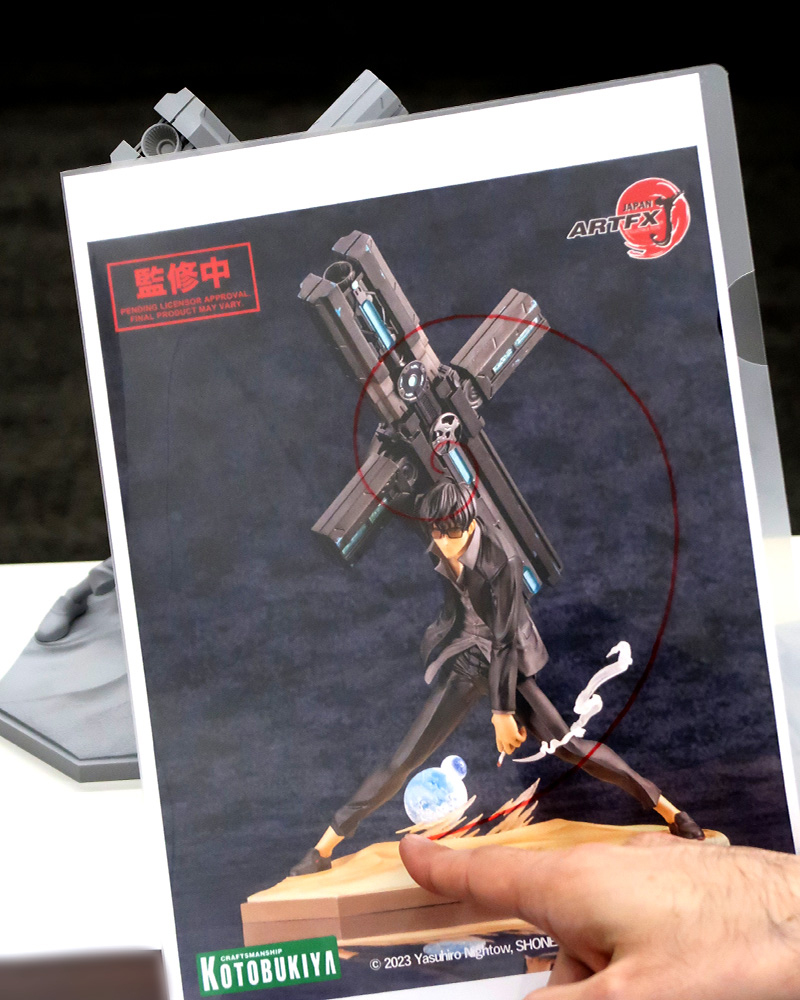
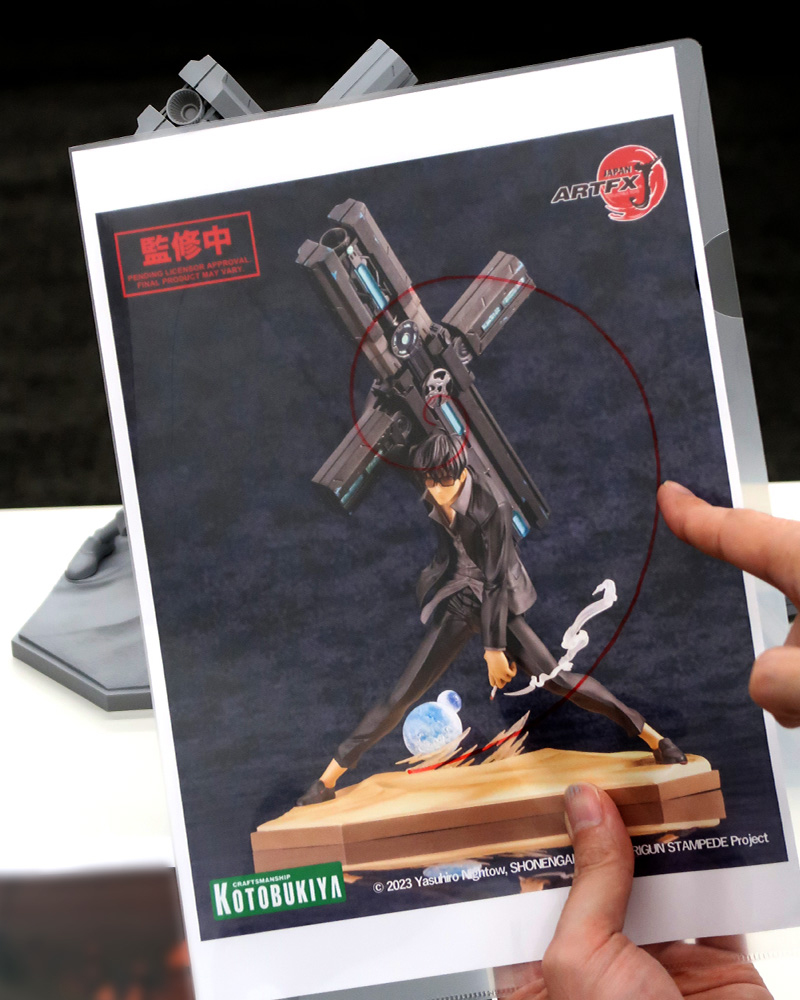
But then one day, I realized, maybe Wolfwood's composition actually fits into the golden ratio.
Staff M:
That's incredible! Can you show us what you mean?
Hattori:
When I tried applying it, the flow of the wind, starting from the sandstorm, spirals around and lands exactly on the Punisher's skull. This isn't something you can plan from the start. It's something I noticed as I was designing the figure. It sort of gave me goosebumps.
Staff M:
That's amazing! I don't think I've ever heard of a figure that incorporates the golden ratio!
Hattori:
It's impossible to design a composition like that from the beginning, so I don't think I'll ever achieve a golden ratio like the one that starts from the wind here again.
Staff M:
So it really is a miraculous pose then!
Hattori:
Yeah, you were saying from the beginning that it's a miracle, that it's beautiful, but I think it all comes back to this.
Staff M:
Maybe this is why I was so obsessed with the figure, haha.
Figures are a visual medium so how they make you feel is really important.
I'm amazed you arrived at the golden ratio.
Hattori:
It was just a coincidence, though.
Staff M:
Still, thank you so much for sharing such a cool story.
Two Bases
Staff M:
Personally, I'm someone who really pays attention to the bases of figures, and when you place Vash and Wolfwood side by side, they form a scene straight out of the world of TRIGUN STAMPEDE. They look even better when displayed together.

Hattori:
When you put Vash and Wolfwood's bases together, you can see five moons behind them. Those familiar with Trigun will immediately know what this means.
Staff M:
Was that something you had planned in advance?
Hattori:
Yes—we intentionally made it five.
Also, since we created that amazing cityscape of Jeneora Rock for Vash, I felt like I had to do something for Wolfwood, too. I ended up making things harder for myself though, haha.
Staff M:
I'm really excited for our next question, but would you mind letting us know about ARTFX J Nicholas D. Wolfwood TRIGUN STAMPEDE Ver. DX Edition?
Hattori:
First off, for all the Kotobukiya Trigun figure fans out there, we've prepared awesome-looking acrylic bases. Which means... That's right! We're giving you extra bases in addition to the desert base, where you can freely display your figures!
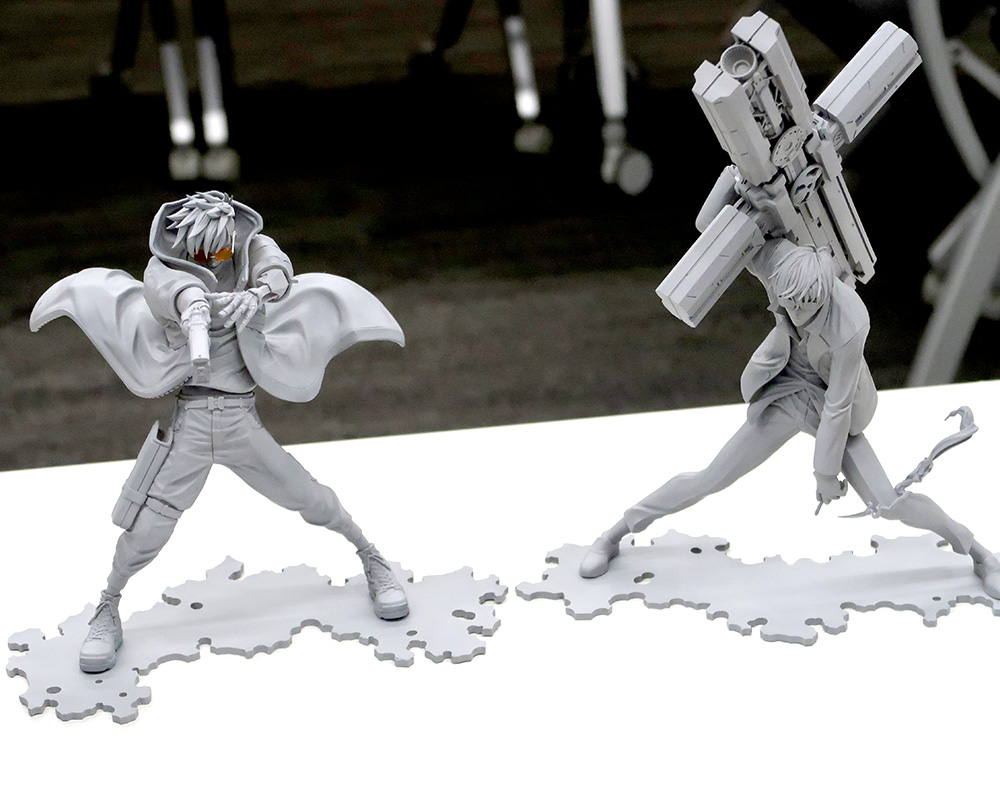
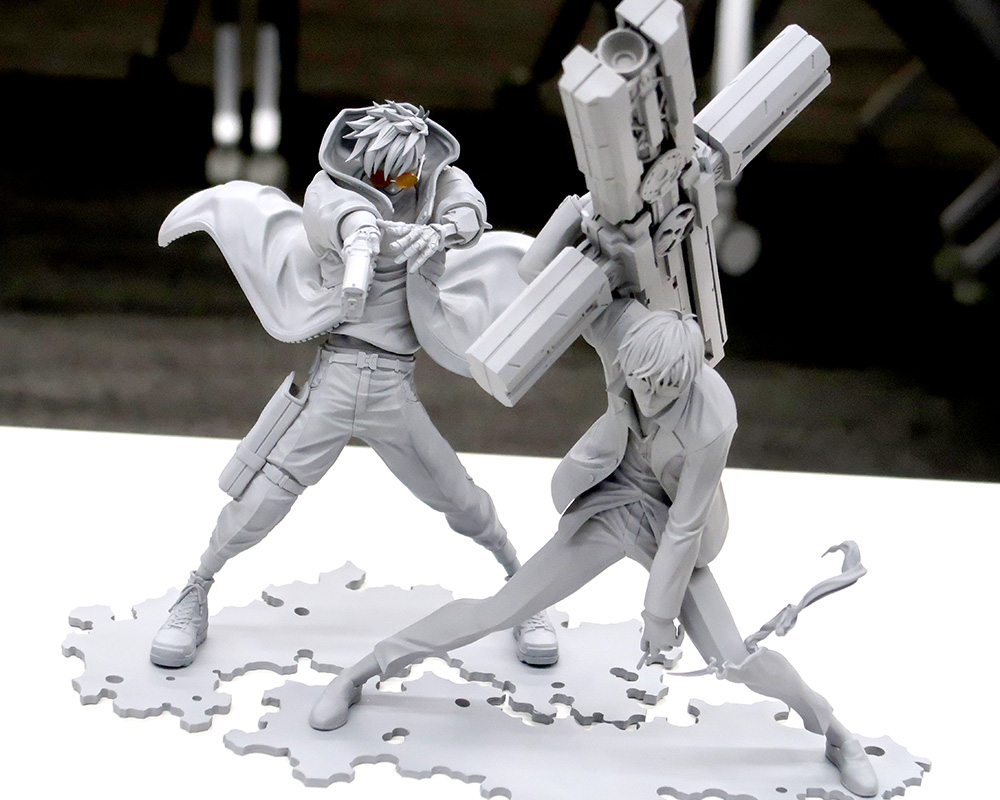
Staff M:
What?! There are TWO bases?! Haha.
Does that mean there's a base for Vash, too?
Hattori:
That's right! So, for those who don't have Vash yet, you have to get him now.
Staff M:
This makes the Vash figure even better as well!
Hattori:
It adds a brand-new layer of fun. You know, with figures, you buy them, take them out, and display them. But this adds another layer of fun.
Staff M:
Now we can display them at the same height as the The Gunman in Black Vash figure.
Hattori:
Yeah, exactly! Fans of the series will surely want to get all three.
And with this acrylic base, you can place them really close together, or anywhere you like, in whatever situation you like.


Staff M:
Oh, nice! So even with limited space, you can display all three.
I never even thought about giving the regular Vash a new base!
Hattori:
You didn't think we'd have even more up our sleeves, did you?
Plus, like The Gunman in Black Vash, the pattern on the base was designed by Ikeda-san from the design team, so it looks super cool too.
Staff M:
The base for The Gunman in Black Vash was so cool. I can't believe you kept this a secret from me too!
Hattori:
Hahahaha!
And now, you can even set them up for a showdown.

Staff M:
I'm definitely getting the DX version!
Hattori:
Yeah, you'll have no regrets if you get the DX version.

Staff M:
Especially since this is the only way to get these acrylic bases.
I'm really looking forward to it. Thanks for telling us all of that.
Finally
Staff M:
Thank you for sharing such valuable insights. This isn't exactly a continuation from last time, but having the figure in front of me, the word craftsmanship really comes to mind. This idea of crafting your work that everyone at Kotobukiya shares. Whether it's about the work itself, the product, or the creation process, everyone pours their heart and soul into it. Craftsmanship is present throughout the entire process that eventually leads to what we see as the final product. It's hard to put into words, but I can't help but smile when I think about the craftsmanship going on behind the scenes.
Hattori:
I think you're someone with that drive for creation.
The last blog interview we did together is one example. The fact that you're able to do something like that is a testament to your ability to create.
Staff M:
It's not just me though. There are like 10 people that work on these posts.
But, I agree, we all embody the spirit of craftsmanship.
And that's why the tiny little details that we discussed today make me so happy whenever I see anyone's creations.
Thanks for telling us all of that.
Hattori:
Thank you.
Staff M:
I'm sure we'll get the chance to talk about craftsmanship again.
Thank you for sitting down with us today.
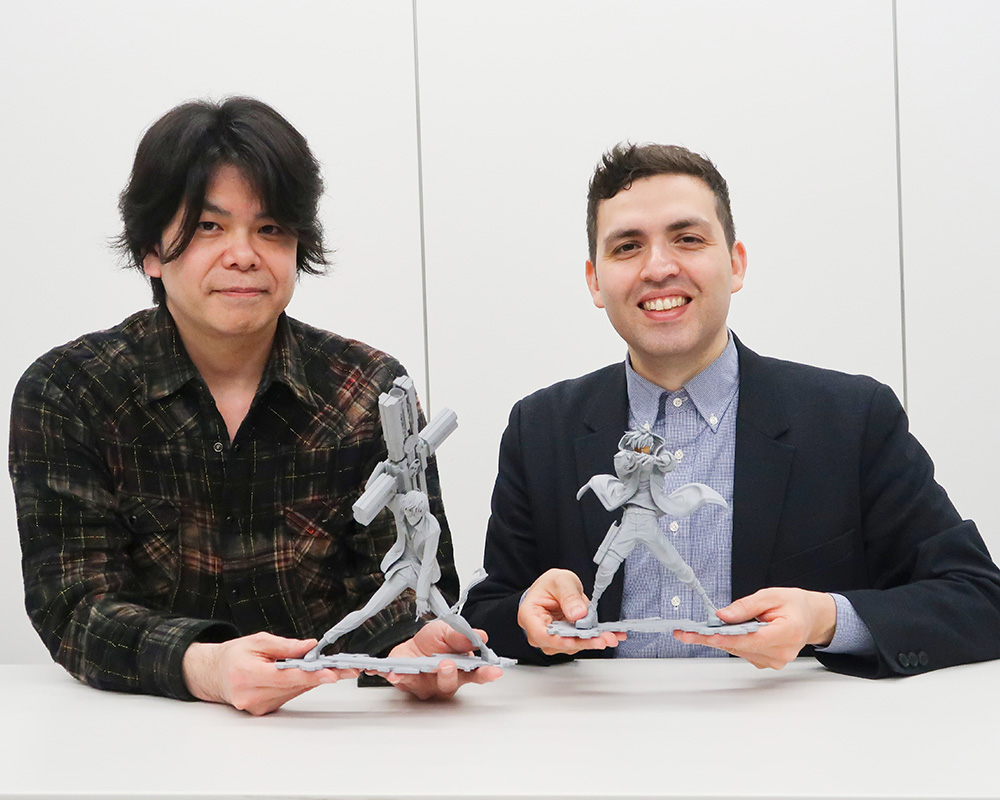
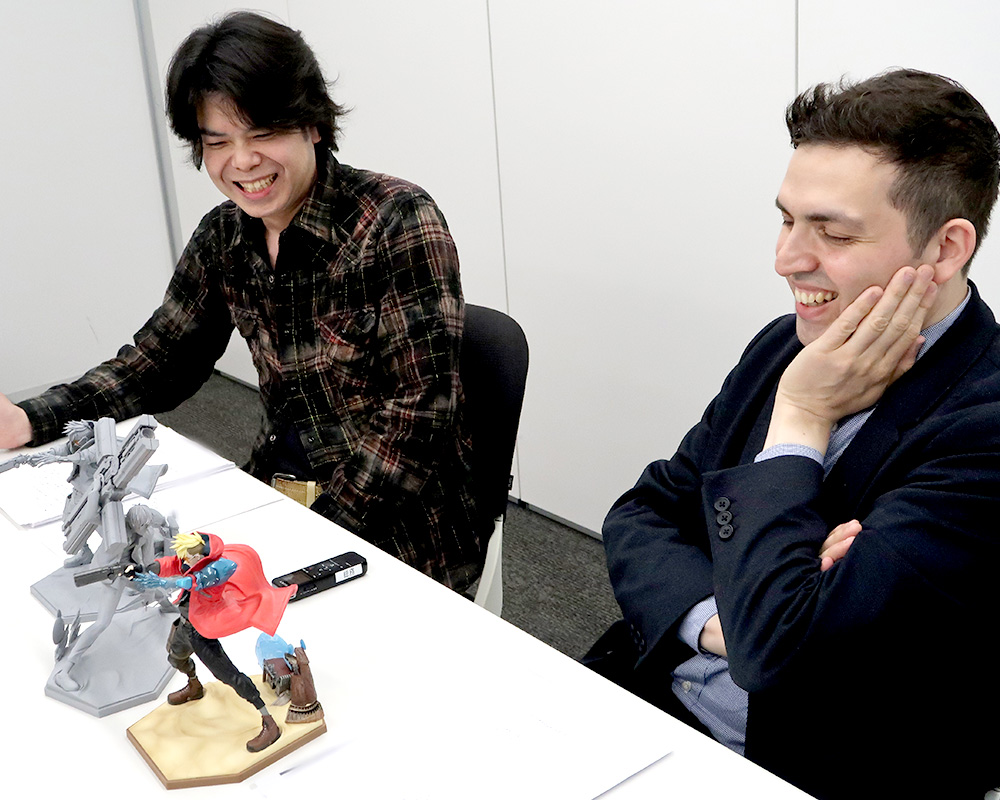
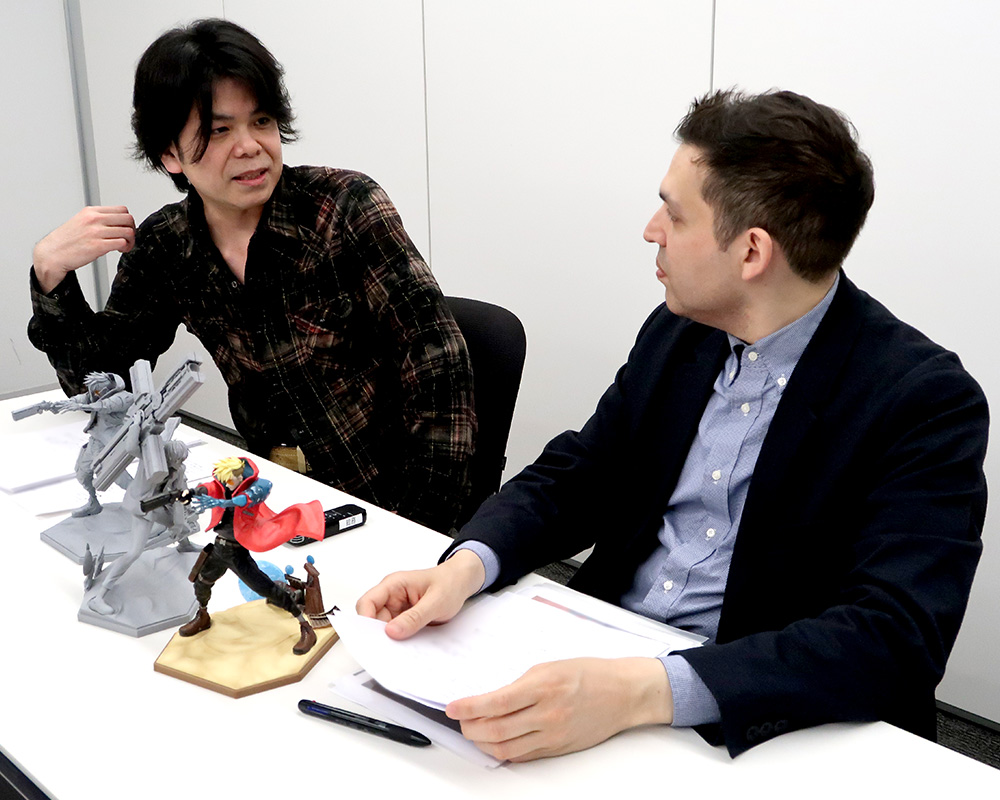
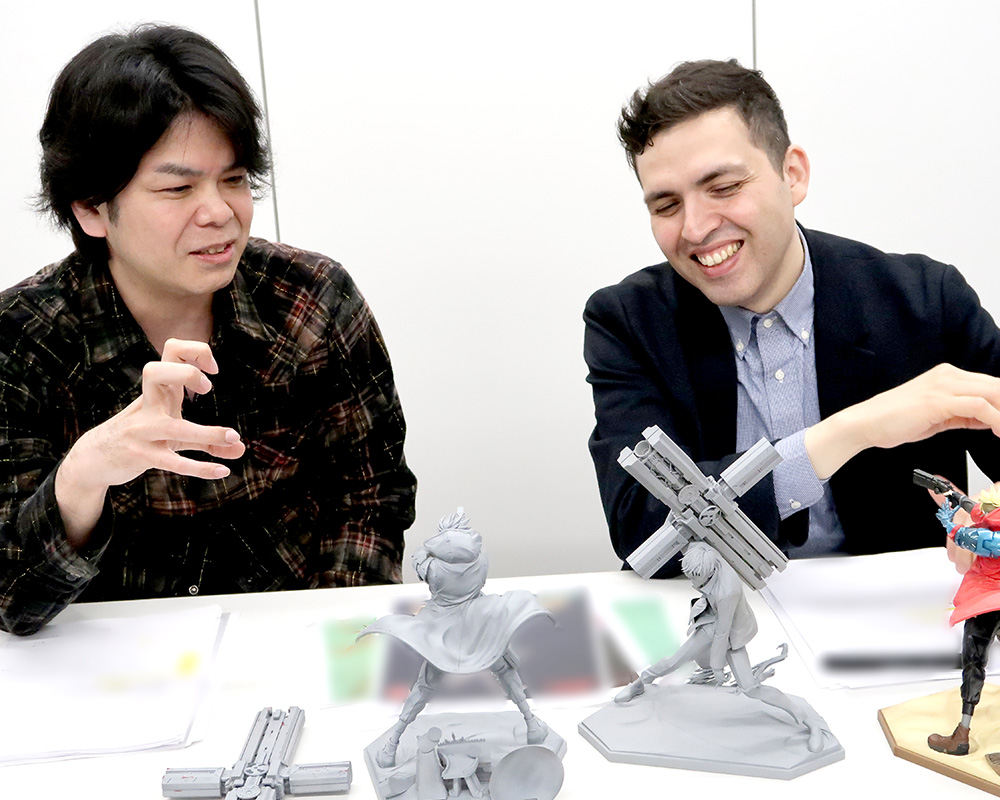
※Left: Tatsuya Hattori (Sculptor) / Right: Staff M (Interviewer)
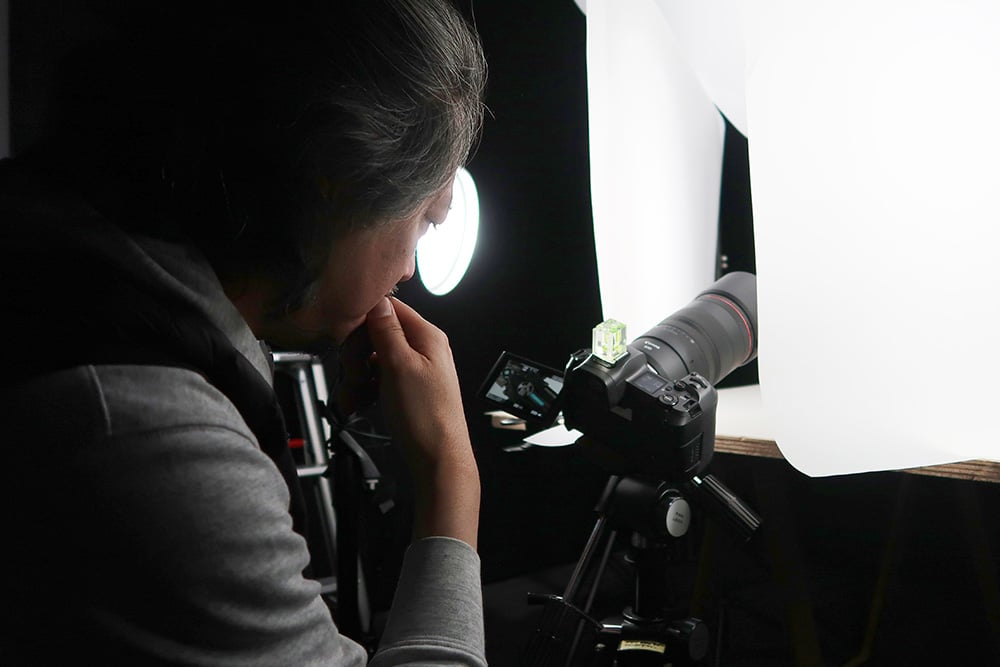
A portion of the sculpt images and all ofthe paint master images were taken by the professional photographer Ken Kubota.
※PROTOTYPES SHOWN, FINAL PRODUCT MAY VARY.
※Colors and composition may change based on photography conditions and your viewing environment.
© 2026 Yasuhiro Nightow, SHONENGAHOSHA / TRIGUN STARGAZE Project